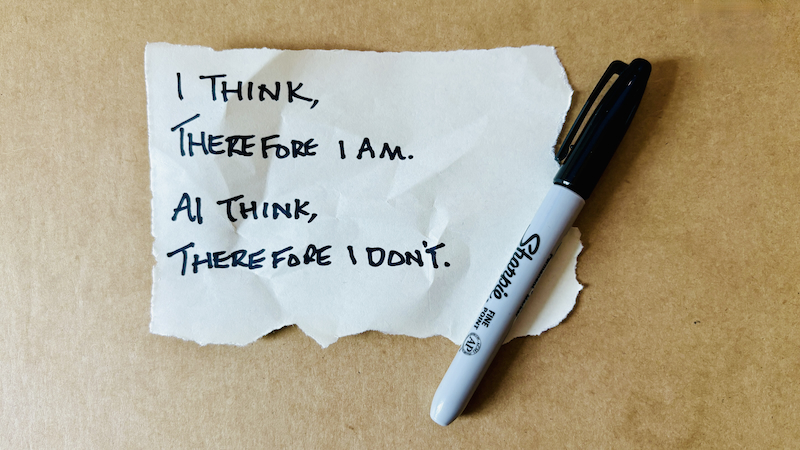
AI thinks, therefore I don’t. This isn’t a point of view. It’s something that happens to our brain, when we offload our thinking to AI. The more we offload, the bigger the impact on us.
I wrote an article on my creative marketing website, which focused on one of the studies from MIT. It’s about AI and cognitive offloading.
MIT used EEG to scan the brains of volunteers in a simple test. One group of was asked to use AI to help them write an essay. Another group was asked to write the essay by themselves.
Despite how simple the task was, the EEG scans of those using AI for the task showed poorer judgement, reduced brain engagement and memory loss, where they couldn’t remember key parts of their essay.
I published a post today over at Creative Thinking Hub. It includes what I’ve discovered to be the root cause of the decline of true, creative thinking. This post has become exceptionally popular in a very short time.
It’s Anti-Creative
I gave the root of the problem a name: Anti-Creative. Here’s the definition.
Anti-Creative:The homogenization of original thought, caused by the pervasive distribution of simplified, prescriptive, and iterative ‘creativity advice’, resulting in a decrease of novel output across a population.
If you want to become more creative in this era of creative decline, I recommend you check out This Anti-Creative era. You’ll discover not only how to survive, but how to absolutely thrive.
Following on from a recent post I published about creatively-designed marketing nonsense, I wanted to share another example.
Black Friday sales.
Surveys show that on average, people save little, if anything at all, from buying a Black Friday ‘deal’. Sky News sited a survey by Which? that showed 8 out of 10 items in these sales are not at their lowest price. Which? found Amazon’s Black Friday deals were cheaper or the same price in 88% of cases before Black Friday.
How does this happen?
It’s a fusion of creative marketing and either bending or breaking the rules. Creative marketing in this instance is simply another way of saying, intentionally misleading creativity.
What a waste of someone’s creativity.
Imagine them getting in from work and being asked, ‘What did you do at work today? Oh, I fooled people into overpaying for products, which the fools think they’re getting a deal on’.
There are so many better paying marketing gigs, than to intentionally mislead people to make bad decisions.
Someone asked me earlier about the role of creativity in marketing. In short, it’s creativity that crafts the message and image. And it has the power to convince intelligent people to do, or believe, some bizarre things.
How? By making them seem like logical and attractive decisions.
Here are 3 common examples, which may come in handy if you want to explain this to someone.
Drinking from jars
In recent years, it’s become fashionable to drink out of jars. Even though the rim of the jars is less comfortable and less secure to drink from, than a purpose-built, regular glass. Thanks to marketing on sites like Instagram and TikTok, it’s fashionable now. And fashion often outweighs common sense.
Making identical commodities feel different
Long before marketing convinced millions of us to drink from jars, major oil companies managed to convince the public that THEIR chemically-identical fuel, is somehow superior. Despite it often coming from the same refineries.
Junk food in the morning
Marketing has positioned ultra-processed, sugary breakfast cereal as a healthy way to start the day.
It’s all creatively-designed marketing nonsense. And it generates billions and billions in sales every year.
Because my brain is weird, the first time I think of an answer, is often when I hear myself answering someone. It comes out of my mouth and that’s the first I know about it.
It happened moments ago. And it gave me a creative spark to share with you. Here’s what happened.
A friend told me that he’s struggling with his creativity. Both in quality and quantity. He then asked me how to improve his creative output.
I then heard myself say, ‘To improve your creative output, improve your creative inputs’.
Fresh feedback from interesting, people, surroundings, conversations, observations and such, are food for the brain. AKA bread for the head. If we make it a habit to regularly connect with different inputs, our minds get to create new points of focus. We’re then better equipped to make the connections that fuel the creative sparks we need.
The next time you’re waiting a little too long for the muse to show up, give it a try.
Our expectations have a huge impact on what we experience. Like they say, we tend to get what we expect.
When faced with a tricky challenge, which requires a creative solution, our solution, or lack of a solution, rests heavily on what we expect. We are only as creative in any situation, as we expect we will be.
I was sparked to write this earlier, when enjoying a coffee in Lincoln, Lincolnshire. The café is very popular and customers tend to reserve a table in advance. A man and woman walked in. The man quickly looked around the room. Within a few seconds, he turned to the woman and with his face like thunder and said, ‘crap, the tables are either taken or reserved!’. They stormed out.
Had he looked at any of the reserved tables, he’d see they have the time of the reservation clearly written on them. On many of the signs, there were 3, 4 or more hours before the table would be required.
At a glance, he expected the reserved signs to mean the tables were unavailable. So, that’s what he saw. And acted accordingly.
Over the years, I’ve learned that in almost every situation, a positive expectancy really helps. Certainly, with my creative work, I always expect to be able to achieve whatever I’m tasked with.
It’s not about being arrogant.
It’s about using positive expectancy as a creativity tool.
If you work in PR or branding, and you’re looking for a new tagline, I came up with this one earlier.
‘We help businesses dress for the reputation they want’.
This creative spark didn’t come from working on a project. It was my best answer to a creative thinking exercise I gave myself. As of Friday 17 October 2025, when I looked for it on the major search engines, in speech marks, there were zero matches.
I’ve always set creative challenges like this for myself. I tend to do it when I’m early for something.
Too little time for me to create meaningful work.
But enough time to respond to a creative challenge.
If you’re trying to spend less time doom scrolling, why not use some of that time sharpening your creativity?
Draw something.
Write something.
It’s the process of creating that matters. Not whatever you happen to draw or write.
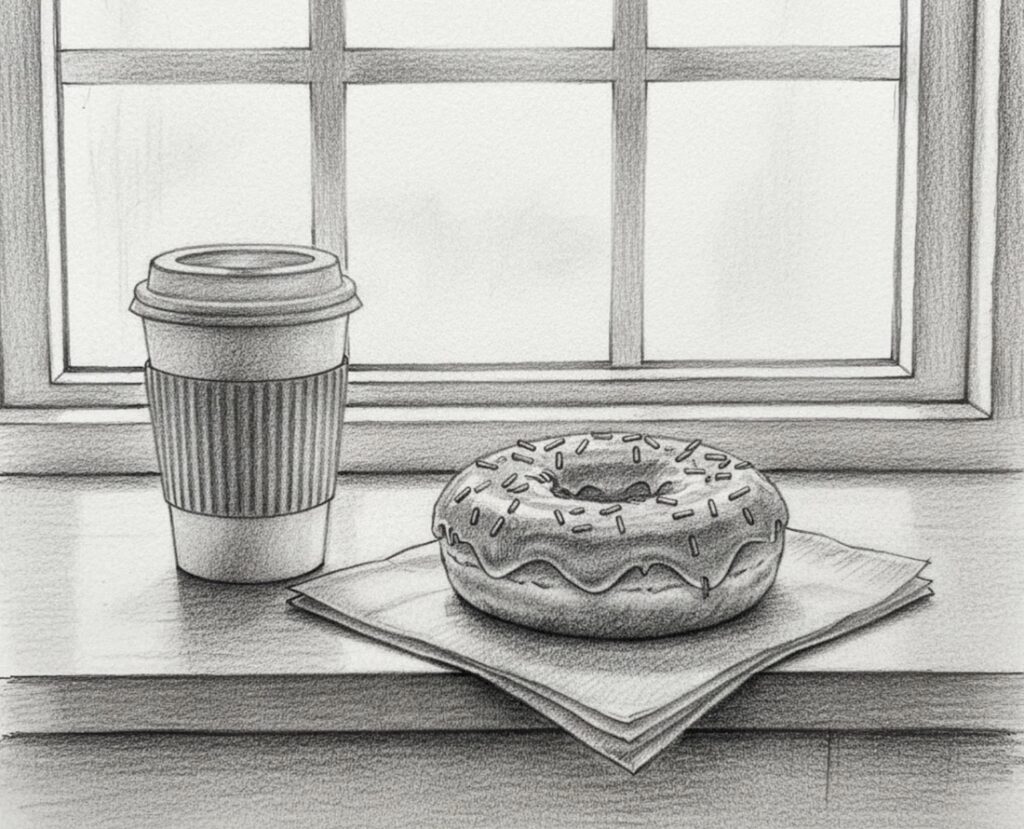
Today’s creative spark post came to me when I walked past a coffee shop earlier. The place smelled of doughnuts. And even though I’m a diet-controlled diabetic, I wanted to go inside.
So I did, though only for a coffee. No doughnuts.
The creative spark
This sparked me to consider, why don’t non-food related stores use attention-grabbing aromas? The aroma will still capture attention.
I checked before writing this and yes, you can buy candles and sprays, which smell just like doughnuts. Remember, I didn’t buy any doughnuts. The smell of doughnuts drew me in, but I made a coffee purchase. And I made it in a coffeeshop I’d never used before.
If I had a store selling toys, art, stationery or whatever, I’d give it a try. For the price of a candle, you could see a sales boost and/or a lot of new faces in your store!
Worst case scenario, you get to enjoy an amazing aroma.
Your written words can have a far greater impact, so long as you know how and where to frame them. Here’s how framing works, including an example from a few hours ago.
I had a coffee after dropping my son off at university. While my cappuccino was being made, a piece of an idea came to me. So, I grabbed a napkin to jot it down.
The piece of an idea was for a client of mine. He’s the managing director of a well-known packaging company. I was playing with some words regarding environmentally friendly packaging.
Our team will help you produce packaging that disappears with grace, not guilt.
It was only after putting my glasses on to start writing, that I noticed the ‘100% recycled’ stamp on the flip side of the napkin. So, I framed my words with the stamp.
Though this was just a part of an idea and didn’t make the cut, the fact that it was framed on a recycled napkin gave it impact.
It caught the barista’s attention.
He then took a photo of it to show to the manager.
She shared it on the company’s social media accounts.
I shared it with a few friends, again, there was far more interest than a poorly-written note deserved.
It was the framing that made all the difference. It was also the story behind the framing of the words, which made it interesting enough for me to share with you.
The wording of the note itself was garbage. Think what would have happened, if that was the finished, creative idea!
Make it work for you
Now imagine yournext important message. Something you want people to take notice of.
Once you’ve decided what you want to say, give your creativity a chance to shine. Think of the best ‘thing’ to frame your message on. And how best to share it.
For example, on the palm of your hand. Then take a photo of it, with your palm facing forward as if to signal STOP! That could work, if you’re protesting against something and have a short message. It would work on social media, too.
Look for a creative connection. Get the framing right and it will massively multiply the impact of your message.