I see you. I am you

Jim Connolly, neurodivergent,

This brief post is for those who have a ‘different’ kind of brain than the general population.

I see you

When you’re different and looking for specific help, and you can’t find anything that addresses your particular problem, I see you.

When you’re frustrated and find it hard to talk about it with friends, because they can’t relate with what you’re thinking, I see you.

When you’re feeling a little too different, I see you.

When you have unanswered questions, and can’t find anything written or recorded about it, I see you.

Thats because…

I am you

It started in 2024. A chance meeting led to me being tested and diagnosed with dyslexia.

Then in 2025, I connected with a neuropsychologist. Here’s what happened. In short, I discovered that damage that had been caused to my brain as a teenager, forced my brain to rewire. Where most people’s brains follow natural, neural highways, mine has access to connections, pathways and shortcuts that don’t usually exist.

Ever since, I haven’t found a single research paper, a book, an article or anything that talks to my specific situation. I asked my neuropsychologist about it and was assured, I won’t find anything specific enough to answer my questions.

You and me

You and me will never fit perfectly in a box. At best, there are broad classifications for some of what makes us different.

Yes, every mind is different. People like us are more different, though.

We have gifts and challenges the vast majority of people do not have.

Can you relate?

The flip side of my creativity and problem solving gifts, is that I have daily challenges. I can’t follow a sequence of instructions beyond the 2nd instruction. I have a tiny working memory, and need to write down or record ideas as soon as I get them, or risk losing them. I’m terrible with numbers. There’s other stuff, too.

My nature is to help others. I feel for those daily challenges you have. And that’s why one of my life missions now, is to do what I can with my gifts and my reach, to support people like us. And to make people more aware of the contributions we can make.

I hope you find this useful.

Anti-Creative: Defined

Anti-Creative, Jim Connolly, Creative thinking
This Anti-Creative era: How to survive?

I published a post today over at Creative Thinking Hub. It includes what I’ve discovered to be the root cause of the decline of true, creative thinking. This post has become exceptionally popular in a very short time.

It’s Anti-Creative

I gave the root of the problem a name: Anti-Creative. Here’s the definition.

If you want to become more creative in this era of creative decline, I recommend you check out This Anti-Creative era. You’ll discover not only how to survive, but how to absolutely thrive.

Intentionally misleading creativity

misleading creativity
Image credit: Gemini

Following on from a recent post I published about creatively-designed marketing nonsense, I wanted to share another example.

Black Friday sales.

Surveys show that on average, people save little, if anything at all, from buying a Black Friday ‘deal’. Sky News sited a survey by Which? that showed 8 out of 10 items in these sales are not at their lowest price. Which? found Amazon’s Black Friday deals were cheaper or the same price in 88% of cases before Black Friday.

How does this happen?

It’s a fusion of creative marketing and either bending or breaking the rules. Creative marketing in this instance is simply another way of saying, intentionally misleading creativity.

What a waste of someone’s creativity.

Imagine them getting in from work and being asked, ‘What did you do at work today? Oh, I fooled people into overpaying for products, which the fools think they’re getting a deal on’.

There are so many better paying marketing gigs, than to intentionally mislead people to make bad decisions.

Creatively-designed, marketing nonsense

creative marketing, jim connolly
Image credit: Gemini

Someone asked me earlier about the role of creativity in marketing. In short, it’s creativity that crafts the message and image. And it has the power to convince intelligent people to do, or believe, some bizarre things.

How? By making them seem like logical and attractive decisions.

Here are 3 common examples, which may come in handy if you want to explain this to someone.

Drinking from jars

In recent years, it’s become fashionable to drink out of jars. Even though the rim of the jars is less comfortable and less secure to drink from, than a purpose-built, regular glass. Thanks to marketing on sites like Instagram and TikTok, it’s fashionable now. And fashion often outweighs common sense.

Making identical commodities feel different

Long before marketing convinced millions of us to drink from jars, major oil companies managed to convince the public that THEIR chemically-identical fuel, is somehow superior. Despite it often coming from the same refineries.

Junk food in the morning

Marketing has positioned ultra-processed, sugary breakfast cereal as a healthy way to start the day.

It’s all creatively-designed marketing nonsense. And it generates billions and billions in sales every year.

Stop being ‘content’: The creative’s guide to digital visibility

creativity, algorithm, human touch, jim connolly

Lots of fellow creatives ask me how to get their work in front of more people, on social media. I think what they really mean, is how can they get their work noticed, remembered and bought, using social media.

Buckle down, because this is not what you’re expecting!

The algorithm business

If you only want your posts to be in front of more people, you need to learn your way around the various algorithms. Or hire someone to do it for you. There are people who work as social media optimisers/managers, who show their clients how to make social media algorithms work for them. This means their clients are no longer free to express themselves in a fully natural way on social media.

It’s all measured, optimised, timed and the ‘content’ needs to be weighted and balanced to conform to the algorithm’s needs.

Here’s my alternative

It’s a very different approach that can be especially powerful for creative professionals like us.

One of the very best ways to make an algorithm work for you, is to IGNORE the bastard.

Hear me out.

Yes, I am saying share what you want to share, say what you want to say, post when you want to post.

No, you will not show up as often in a social media feed, as you would if you danced to the algorithm’s tune.

But when you do appear, you’ll command more interest and form deeper connections with prospects, who become attracted to your refreshing, relatable, human, social media presence.

  • You’ll be more memorable. Because you’ll be one of the few voices out there, which is algorithm-free and truly authentic
  • You’ll add more colour to people’s social feeds. Because the colour of algorithm ‘content’ is beige. It’s literally just content. Not fully creative. Not free-flowing, but stuff that’s partly designed for algorithms and partly designed for humans

As a result, creatives who follow the algorithm’s rules, find they lose people’s attention. Why? Because part of that creative individual’s personality is being stripped from their content.

How come?

  • Some of their spontaneity is lost. This is part of what makes you human. And that’s a big deal, in an age where you’re competing against mass produced AI.
  • Some of their creative voice is lost, because it doesn’t comply with the needs of the algorithm. This alienates you from the very people you want to buy from you or hire you. 
  • Some of their uniqueness is lost, as it has an over-familiar, algorithmic rhythm. People communicate an a natural way, with a natural flow. When we strip this away, we put ourselves at a huge disadvantage.

Here’s the thing: there’s a price to pay for using carefully balanced combinations of words, hashtags, images, videos, threaded posts, etc. It’s the price we all pay, if we choose to be too similar to our competitors.

We fade to beige

When we’re beige, we become part of the background. While LOTS of people will see us, few, if any, will notice us.

Eh?

Imagine you’re in a massive sporting arena. There are 30,000 people opposite you, dressed from head to foot in red. Then, someone dressed head to foot in yellow walks in and stands amongst them. That’s the person who stands out. The 30,000 people become a background for that person in yellow.

In that analogy, the person in yellow is the creative soul, who understands the difference between vanity metrics and human-to-human connection. There may be just one of them, but once they catch your eye, they’re the person your focus is on.

Is there a way to optimise for social media that does a bit of both?

No. At least, not so you get to be your true, creative self.

Using AI or a social media manager to automate and optimize your social media, is neither one thing or the other. It’s a trade-off. A trade-off that could be robbing you and your work of the visibility and connection you need right now. 

Violent opposition from mediocre minds

Einstein

Photo by Taton Moïse on Unsplash

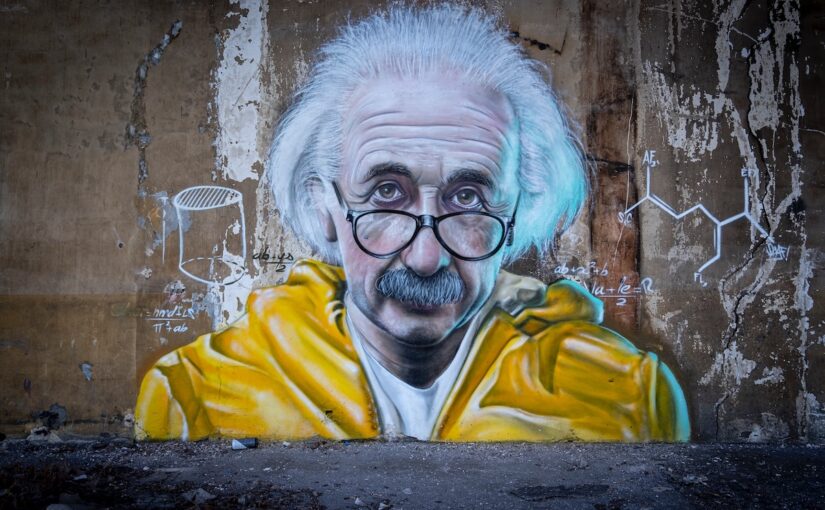
Mention Marie Curie to most people today and they’ll know her name. Many will also know of her pioneering work on radioactivity. This, despite her passing away in 1934.

Mention the names of those who wrote and spoke appallingly about her, no one remembers them.

Einstein saw what was happening to Marie Curie and was impelled to write to her.

I am impelled to tell you how much I have come to admire your intellect, your drive, and your honesty[…] If the rabble continues to occupy itself with you, then simply don’t read that hogwash, but rather leave it to the reptile for whom it has been fabricated.

Einstein to Marie Curie.

Einstein made a similar point in a letter of March 1940. He told the professor of philosophy at the City College of New York. ‘Great spirits have always encountered violent opposition from mediocre minds.

Standing out and the rabble

Outstanding people, creating outstanding art, will obviously stand out.

Their thinking, vision and output is rare.
So rare, that the mediocre minded rabble can’t understand it. However, that same mediocre mind feels forced to loudly express its uninformed opinion. Empty vessels, and all that.

Never allow the rabble to derail your creativity.

Yes, by all means get informed feedback from trusted, proven experts. But if you believe in what you’re doing, and it’s for the greater good, do it.

Creative productivity: Inputs and outputs

creative thinking, input output, creative productivity, creative sparks

Because my brain is weird, the first time I think of an answer, is often when I hear myself answering someone. It comes out of my mouth and that’s the first I know about it.

It happened moments ago. And it gave me a creative spark to share with you. Here’s what happened.

A friend told me that he’s struggling with his creativity. Both in quality and quantity. He then asked me how to improve his creative output.

I then heard myself say, ‘To improve your creative output, improve your creative inputs’.

Fresh feedback from interesting, people, surroundings, conversations, observations and such, are food for the brain. AKA bread for the head. If we make it a habit to regularly connect with different inputs, our minds get to create new points of focus. We’re then better equipped to make the connections that fuel the creative sparks we need.

The next time you’re waiting a little too long for the muse to show up, give it a try.

Well, what did you expect?

creativity, positive expectations, mindset, David Robson

Our expectations have a huge impact on what we experience. Like they say, we tend to get what we expect.

When faced with a tricky challenge, which requires a creative solution, our solution, or lack of a solution, rests heavily on what we expect. We are only as creative in any situation, as we expect we will be.

That’s because, as author David Robson says in ‘The Expectation Effect‘, our brains are like prediction machines.

I was sparked to write this earlier, when enjoying a coffee in Lincoln, Lincolnshire. The café is very popular and customers tend to reserve a table in advance. A man and woman walked in. The man quickly looked around the room. Within a few seconds, he turned to the woman and with his face like thunder and said, ‘crap, the tables are either taken or reserved!’. They stormed out.

Had he looked at any of the reserved tables, he’d see they have the time of the reservation clearly written on them. On many of the signs, there were 3, 4 or more hours before the table would be required.

At a glance, he expected the reserved signs to mean the tables were unavailable. So, that’s what he saw. And acted accordingly.

Over the years, I’ve learned that in almost every situation, a positive expectancy really helps. Certainly, with my creative work, I always expect to be able to achieve whatever I’m tasked with.

It’s not about being arrogant.

It’s about using positive expectancy as a creativity tool.

Photo by Rod Long on Unsplash

Uniformed creativity? Looks like it.

creatives, creative thinking, art studio

I’ve seen many art studios and met even more artists, over the years.

While walking this morning, I was sparked by something I’d never given any thought to before.

Why do so many artists look like artists and work from such similar looking studios?

Whilst those who work in the same medium will obviously need similar tools, the way the actual studio looks can be whatever the artist wants it to be. Yet so many choose the same, this is what an artists studio is supposed to look like, look. There are exceptions to this. But that’s the thing, they are exceptions.

If you were to have a random group of 50 people, all dressed in their typical, daily clothing, and only 1 of them was an artist, you’d know who the artist was. It’s the 1 who’s dressed, and styled, like an artist. There are exceptions to this. But that’s the thing, they are exceptions.

Let’s compare the above, to artists who primarily work as dancers, authors or actors, etc. You’d struggle to pick them out from a crowd.

Then, I realised that even the best-known, most respected and valued artists do exactly the same. They look like artists and work in what an artist’s studio is expected to look like.

It’s clearly no barrier to talent.

But uniformed creativity feels like an oxymoron.

Creative thinking exercises

creativity, creative mind

If you work in PR or branding, and you’re looking for a new tagline, I came up with this one earlier.

‘We help businesses dress for the reputation they want’. 

This creative spark didn’t come from working on a project. It was my best answer to a creative thinking exercise I gave myself. As of Friday 17 October 2025, when I looked for it on the major search engines, in speech marks, there were zero matches.

I’ve always set creative challenges like this for myself. I tend to do it when I’m early for something.

  • Too little time for me to create meaningful work.
  • But enough time to respond to a creative challenge.

If you’re trying to spend less time doom scrolling, why not use some of that time sharpening your creativity?

Draw something.

Write something.

It’s the process of creating that matters. Not whatever you happen to draw or write.

Give it a try and see what happens.