Others say, it’s only because those people are already highly creative, that they can produce something daily.
Which answer is correct?
Both.
Creativity is sparked in different ways, with different people. And as we all know, it’s often sparked when we’re not even trying, and it often goes missing when we try too hard.
Seeking creativity is, in itself, a highly creative and personal thing. Try things. Mix things up. Keep what works, trash what doesn’t.
Today’s creative spark came to me while I was looking for a specific quotation, for a project I’m working on. I found the quote and it immediately provided me with a wide-ranging creativity tactic.
The quote came from the brilliant mind of Roy Peter Clark. It was part of some advice he shared to an aspiring author, who was struggling and asked Roy for help.
This is what jumped out at me.
Draft earlier than you think you can. Not even a first draft, but a Zero Draft.
One of the great barriers to creativity is fear. Fear stops us getting started. Fear of failure, criticism, people laughing at us, whatever. If we don’t start, we don’t finish. We fail to create or produce anything. We’re creatively blocked!
Roy knew that a great way to start writing a book, is to write something free from the fear of failure.
A first draft carries expectation. A zero draft carries none. The stakes are as low as possible. The barrier of fear is removed. And the struggling author now has the freedom to get started. Once started, momentum is built. And they’re writing.
Whatever kind of creative work we’re struggling to get started, by adding our own version of a zero draft, we too can get moving. We’re free to start on something where there’s zero expectation, the stakes are lower than low and the barrier is removed.
I heard an artist talking about this recently. It’s causing her to doubt her art and wonder if she’s pricing her work too high. This sparked me to explain why the core problem is seldom the quality of the art or the price.
Don’t assume your problem is that your art isn’t good enough or that you charge too much. This is what a lot of great artists do. And it causes many to doubt themselves and change their unique style or lower their prices.
Neither of those assumptions will help you.
If your art is wonderful and your prices are too low.
Or if your art is wonderful, your prices are pitched perfectly, but you’re putting your art in front of the wrong type of people.
Or if all the above is correct, but you haven’t created a compelling story about you, the artist. By the way: Your story is really important.
Before you doubt your art or undervalue it, look at external factors and make sure they’re not the culprit.
There’s a market for everyone’s art. Including yours.
Your written words can have a far greater impact, so long as you know how and where to frame them. Here’s how framing works, including an example from a few hours ago.
I had a coffee after dropping my son off at university. While my cappuccino was being made, a piece of an idea came to me. So, I grabbed a napkin to jot it down.
The piece of an idea was for a client of mine. He’s the managing director of a well-known packaging company. I was playing with some words regarding environmentally friendly packaging.
Our team will help you produce packaging that disappears with grace, not guilt.
It was only after putting my glasses on to start writing, that I noticed the ‘100% recycled’ stamp on the flip side of the napkin. So, I framed my words with the stamp.
Though this was just a part of an idea and didn’t make the cut, the fact that it was framed on a recycled napkin gave it impact.
It caught the barista’s attention.
He then took a photo of it to show to the manager.
She shared it on the company’s social media accounts.
I shared it with a few friends, again, there was far more interest than a poorly-written note deserved.
It was the framing that made all the difference. It was also the story behind the framing of the words, which made it interesting enough for me to share with you.
The wording of the note itself was garbage. Think what would have happened, if that was the finished, creative idea!
Make it work for you
Now imagine yournext important message. Something you want people to take notice of.
Once you’ve decided what you want to say, give your creativity a chance to shine. Think of the best ‘thing’ to frame your message on. And how best to share it.
For example, on the palm of your hand. Then take a photo of it, with your palm facing forward as if to signal STOP! That could work, if you’re protesting against something and have a short message. It would work on social media, too.
Look for a creative connection. Get the framing right and it will massively multiply the impact of your message.
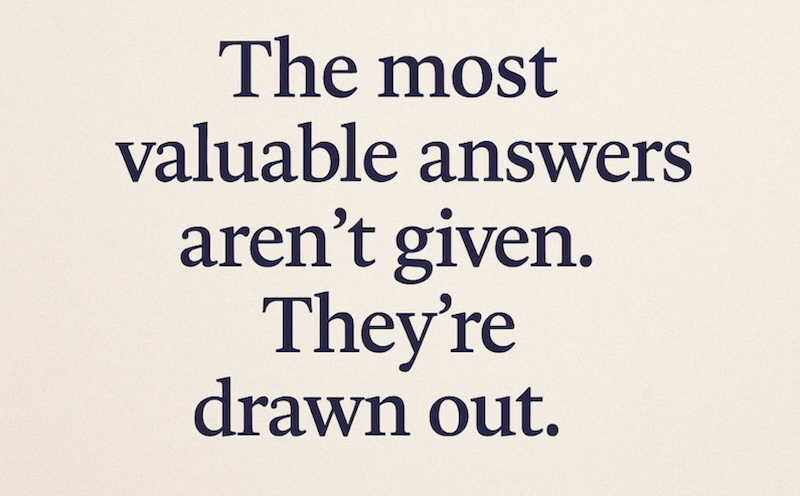
In my experience, the answers that provide real significance and value are usually the result of a deliberate effort to uncover them. Rather than being simply handed over.
The journey itself, greatly increases what you learn.
I recently started to do a lot more of my note-taking, organically. Pen and paper. In notebooks or on scraps of paper.
Over the past 6 months, I’d slowly switched over to doing the vast majority of my note-taking digitally. Either on my phone, iPad or Macs.
But I noticed that something was missing from my notes and creative output. Digital is certainly far more efficient. However, I’m not sure as a creative professional, that efficiency is of first importance.
I think I’ve now discovered what’s missing.
I believe that what’s been missing is the overall experience of working with my hands. Using tools. This changes how I feelwhen I write. These feelings then change what I write.
There’s a creative spark, at least for me, when working with raw tools, with ink on my fingers, playing with sticky notes and swapping between pens and notebooks.
Since (re)adding analogue notes to my creativity mix, I’ve noticed an increase in my productivity. In fact, I’ve revived this site and started to share some of the ideas that come to mind. It could be a flash in the pan. Time will tell.
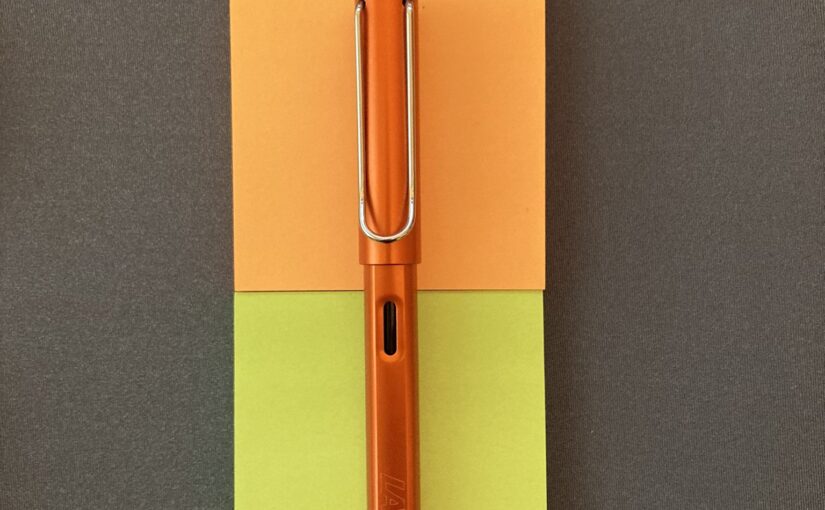
FYI, the above photo is today’s pen of choice. A Lamy Al Star.
If you have 3 diamonds, and you give 1 of them to a stranger, you are left with 2 diamonds. Give all 3 diamonds away and you will be left with none.
If you give someone an idea, 3 ideas or 300 ideas, you still have just as many ideas as you had before.
The smartest people are generous with their ideas. They know that ideas given away are shared, not lost. They’re stingy with those things that are irreplaceable, like their time. But not their ideas.