Jim Connolly is a creativity expert. His brain was rewired after childhood brain trauma. This allows him to see solutions and patterns that don't follow conventional logic. Artists, inventors and businesses hire Jim when they need answers, fast.
Because my brain is weird, the first time I think of an answer, is often when I hear myself answering someone. It comes out of my mouth and that’s the first I know about it.
It happened moments ago. And it gave me a creative spark to share with you. Here’s what happened.
A friend told me that he’s struggling with his creativity. Both in quality and quantity. He then asked me how to improve his creative output.
I then heard myself say, ‘To improve your creative output, improve your creative inputs’.
Fresh feedback from interesting, people, surroundings, conversations, observations and such, are food for the brain. AKA bread for the head. If we make it a habit to regularly connect with different inputs, our minds get to create new points of focus. We’re then better equipped to make the connections that fuel the creative sparks we need.
The next time you’re waiting a little too long for the muse to show up, give it a try.
Our expectations have a huge impact on what we experience. Like they say, we tend to get what we expect.
When faced with a tricky challenge, which requires a creative solution, our solution, or lack of a solution, rests heavily on what we expect. We are only as creative in any situation, as we expect we will be.
I was sparked to write this earlier, when enjoying a coffee in Lincoln, Lincolnshire. The café is very popular and customers tend to reserve a table in advance. A man and woman walked in. The man quickly looked around the room. Within a few seconds, he turned to the woman and with his face like thunder and said, ‘crap, the tables are either taken or reserved!’. They stormed out.
Had he looked at any of the reserved tables, he’d see they have the time of the reservation clearly written on them. On many of the signs, there were 3, 4 or more hours before the table would be required.
At a glance, he expected the reserved signs to mean the tables were unavailable. So, that’s what he saw. And acted accordingly.
Over the years, I’ve learned that in almost every situation, a positive expectancy really helps. Certainly, with my creative work, I always expect to be able to achieve whatever I’m tasked with.
It’s not about being arrogant.
It’s about using positive expectancy as a creativity tool.
I’ve seen many art studios and met even more artists, over the years.
While walking this morning, I was sparked by something I’d never given any thought to before.
Why do so many artists look like artists and work from such similar looking studios?
Whilst those who work in the same medium will obviously need similar tools, the way the actual studio looks can be whatever the artist wants it to be. Yet so many choose the same, this is what an artists studio is supposed to look like, look. There are exceptions to this. But that’s the thing, they are exceptions.
If you were to have a random group of 50 people, all dressed in their typical, daily clothing, and only 1 of them was an artist, you’d know who the artist was. It’s the 1 who’s dressed, and styled, like an artist. There are exceptions to this. But that’s the thing, they are exceptions.
Let’s compare the above, to artists who primarily work as dancers, authors or actors, etc. You’d struggle to pick them out from a crowd.
Then, I realised that even the best-known, most respected and valued artists do exactly the same. They look like artists and work in what an artist’s studio is expected to look like.
If you work in PR or branding, and you’re looking for a new tagline, I came up with this one earlier.
‘We help businesses dress for the reputation they want’.
This creative spark didn’t come from working on a project. It was my best answer to a creative thinking exercise I gave myself. As of Friday 17 October 2025, when I looked for it on the major search engines, in speech marks, there were zero matches.
I’ve always set creative challenges like this for myself. I tend to do it when I’m early for something.
Too little time for me to create meaningful work.
But enough time to respond to a creative challenge.
If you’re trying to spend less time doom scrolling, why not use some of that time sharpening your creativity?
Draw something.
Write something.
It’s the process of creating that matters. Not whatever you happen to draw or write.
Others say, it’s only because those people are already highly creative, that they can produce something daily.
Which answer is correct?
Both.
Creativity is sparked in different ways, with different people. And as we all know, it’s often sparked when we’re not even trying, and it often goes missing when we try too hard.
Seeking creativity is, in itself, a highly creative and personal thing. Try things. Mix things up. Keep what works, trash what doesn’t.
Today’s creative spark is about using your age, at any age, as a source of power and a springboard to live your best life, and/or do your best work.
Let’s go!
When I started the business I currently own and run, I was just 29-years old. Not only that, I looked like I was in my early 20s. It was tricky to get people who were in their 40’s and 50’s, to hire a guy who looked half their age, for my expert advice.
So, I decided to use my youth as a major plus. I told myself that youth was like a superpower, which brought boundless energy and ambition. It worked. My newfound confidence attracted people who valued that kind of vigour and relentless positivity.
This month, I celebrated my 60th birthday.
In my profession as a creative problem solver, 60 is a golden age. It’s when you have the experience, the knowledge, the connections, the track record and the reputation to make it easy to hire you.
I’m looking forward to my 60s and all the new opportunities this will bring. A lot of this is down to my mindset. Many people I’ve known have reached 60, then suddenly started to sound old.
Last weekend I connected with an artist who’s 89 years-old.
He walks with a stick and has a few health issues. And every day of his life he paints, draws or writes something. His art is wonderful. His outlook is is one of relentless positivity and his love for life is inspirational.
He said that when collectors of his work contact him, he always replies. If they write him a letter including a stamped, addressed envelope, he posts them a reply, which occasionally contains a very simple sketch.
My point?
For those who feel their age is a barrier to their success: like they’re too young, too middle aged or too old, it isn’t.
That age barrier exists in your mind.
Yes, their absolutely are some who refuse to hire people for certain positions, once they pass a certain age. But there are more people who hire the person, and not how many candles someone had on this year’s birthday cake.
Use your age as a superpower.
An opportunity to flourish.
A moment in time to embrace the potential still within you.
Today’s creative spark came to me while I was looking for a specific quotation, for a project I’m working on. I found the quote and it immediately provided me with a wide-ranging creativity tactic.
The quote came from the brilliant mind of Roy Peter Clark. It was part of some advice he shared to an aspiring author, who was struggling and asked Roy for help.
This is what jumped out at me.
Draft earlier than you think you can. Not even a first draft, but a Zero Draft.
One of the great barriers to creativity is fear. Fear stops us getting started. Fear of failure, criticism, people laughing at us, whatever. If we don’t start, we don’t finish. We fail to create or produce anything. We’re creatively blocked!
Roy knew that a great way to start writing a book, is to write something free from the fear of failure.
A first draft carries expectation. A zero draft carries none. The stakes are as low as possible. The barrier of fear is removed. And the struggling author now has the freedom to get started. Once started, momentum is built. And they’re writing.
Whatever kind of creative work we’re struggling to get started, by adding our own version of a zero draft, we too can get moving. We’re free to start on something where there’s zero expectation, the stakes are lower than low and the barrier is removed.
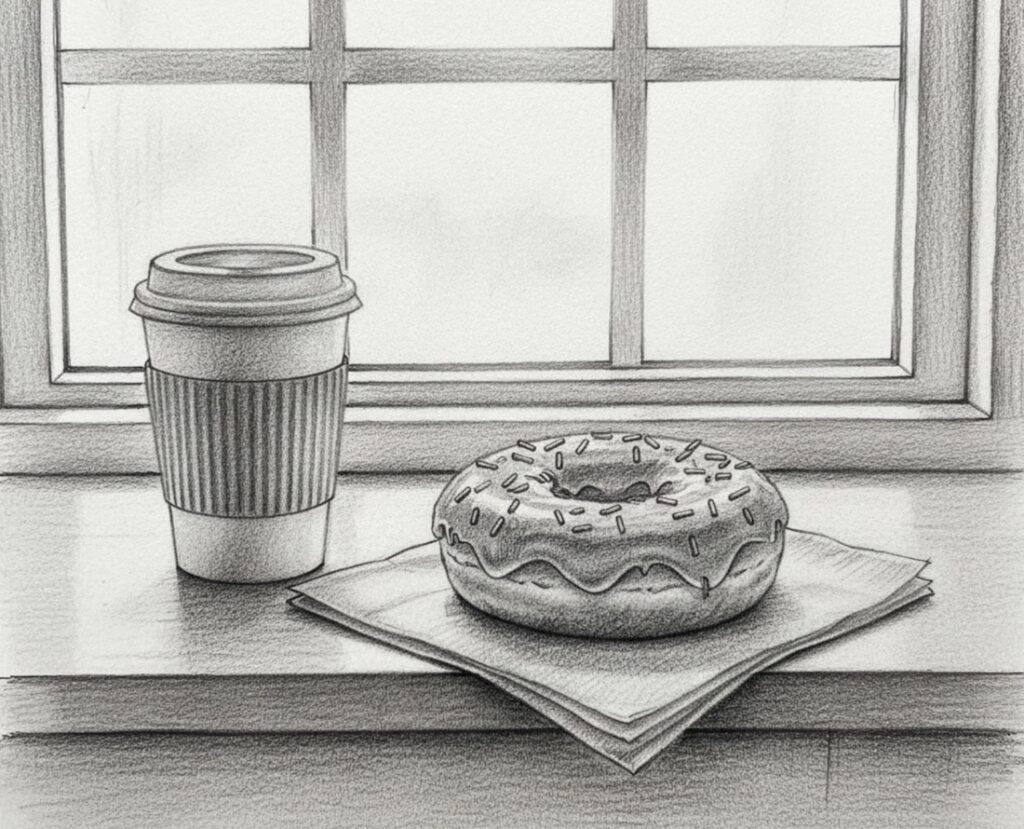
Today’s creative spark post came to me when I walked past a coffee shop earlier. The place smelled of doughnuts. And even though I’m a diet-controlled diabetic, I wanted to go inside.
So I did, though only for a coffee. No doughnuts.
The creative spark
This sparked me to consider, why don’t non-food related stores use attention-grabbing aromas? The aroma will still capture attention.
I checked before writing this and yes, you can buy candles and sprays, which smell just like doughnuts. Remember, I didn’t buy any doughnuts. The smell of doughnuts drew me in, but I made a coffee purchase. And I made it in a coffeeshop I’d never used before.
If I had a store selling toys, art, stationery or whatever, I’d give it a try. For the price of a candle, you could see a sales boost and/or a lot of new faces in your store!
Worst case scenario, you get to enjoy an amazing aroma.
I heard an artist talking about this recently. It’s causing her to doubt her art and wonder if she’s pricing her work too high. This sparked me to explain why the core problem is seldom the quality of the art or the price.
Don’t assume your problem is that your art isn’t good enough or that you charge too much. This is what a lot of great artists do. And it causes many to doubt themselves and change their unique style or lower their prices.
Neither of those assumptions will help you.
If your art is wonderful and your prices are too low.
Or if your art is wonderful, your prices are pitched perfectly, but you’re putting your art in front of the wrong type of people.
Or if all the above is correct, but you haven’t created a compelling story about you, the artist. By the way: Your story is really important.
Before you doubt your art or undervalue it, look at external factors and make sure they’re not the culprit.
There’s a market for everyone’s art. Including yours.
Welcome to my first CSOTD, Creative Spark Of The Day, post.
Note: If you haven’t heard why my brain is weird, the following will not make as much sense.
Most of us know how designers often borrow heavily from other designers. Jony Ive’s use of fellow industrial designer Dieter Rams’ designs, for Apple’s iPod, iMac and calculator app are well documented.
But Ive’s work was only a few decades after Rams’ original design. Ive had to acknowledge Rams’ influence because it was so obvious.
The creative spark
Yesterday was my wife’s birthday. As she’s a historian, I took her for lunch at the 950(ish)-year old Lincoln Castle. Within moments of entering the grounds, I was sparked by the huge selection of inspiring patterns, textures, colours, graffiti, arches, decretive stone work and shapes.
Castles and most other very old buildings, provide a gold mine of creative inspiration.
For who?
Off the top of my head, I thought of creatives in fashion, branding, textiles, ceramics, jewellery, authors, game developers, haberdashery, web design and furniture makers. Plus anyone looking for a radical change of scenery to get their creative juices flowing.
Yes, a creative in any of the above areas can take inspiration from an earlier period in their field. And that’s what many of them do.
But by taking inspiration from something so distant in time and so dissimilar to what you’re seeking to create, you can create work that truly stands out.